



Multi-Cavity and Family Injection Molding
Maximize each shot with multiples of the same or different parts from a single mold
Certification
ISO 9001:2015
What is Family and Multi-Cavity Molding?
Family molding and multi-cavity molding are injection molding techniques designed to increase production efficiency by manufacturing multiple parts in a single molding cycle.
Multi-cavity molding uses a mold containing multiple identical cavities, allowing several copies of the same part to be produced with each shot. This approach is ideal for high-volume production and helps reduce cost per part.
Family molding, on the other hand, utilizes a mold with different cavity designs to produce multiple related components simultaneously—such as matching left- and right-hand parts or components that are assembled together in the final product.
Both methods improve manufacturing efficiency, reduce cycle costs, and optimize production throughput for large-volume applications.
Family and Multi-Cavity Molding Capabilities
Our engineering guidelines for family and multi-cavity molds are designed to maximize manufacturability, improve part consistency and appearance, and streamline production for greater efficiency and lower overall costs.
Tolerances: Typically, Protolabs can maintain a machining tolerance of +/- 0.003 in. (0.08mm) with an included resin tolerance that can be greater than but no less than +/- 0.002 in./in. (0.002mm/mm).
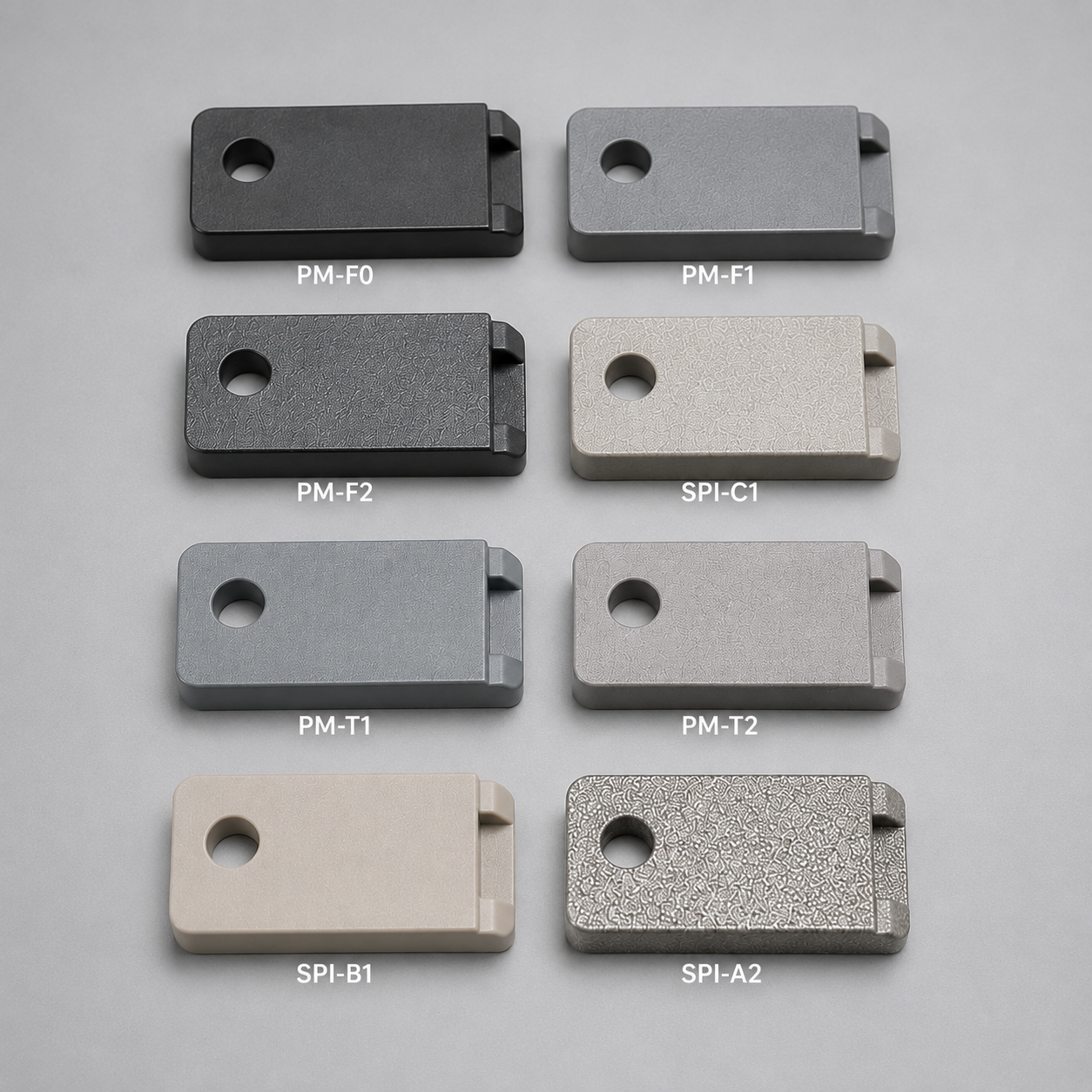
Surface Finish Options
| Finish | Description |
|---|---|
| PM-F0 | non-cosmetic, finish to Protolabs' discretion |
| PM-F1 | low-cosmetic, most toolmarks removed |
| PM-F2 | non-cosmetic, EDM permissible |
| SPI-C1 | 600 grit stone |
| PM-T1 | SPI-C1 + light bead blast |
| PM-T2 | SPI-C1 + medium bead blast |
| SPI-B1 | 600 grit paper |
| SPI-A2 | grade #2 diamond buff |
How Does Multi-Cavity or Family Molding Work?
Multi-cavity molding uses a single mold containing multiple identical cavities to produce several copies of the same part in each cycle, improving throughput and lowering unit costs.
Family molding expands on this concept by combining multiple different but related components within one mold, enabling an entire set of mating or assembly parts to be produced in a single shot.
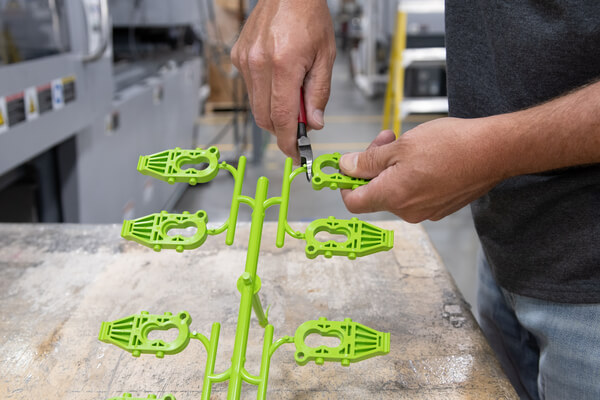
The molded parts remain connected by a runner system and are separated after molding, similar to the components found in plastic model kits.
This approach helps streamline production, reduce tooling investment, and improve manufacturing efficiency for higher-volume applications.
Benefits
- Higher Production Output – Produce multiple parts in every molding cycle.
- Greater Efficiency – Maximize machine utilization and manufacturing throughput.
- Lower Unit Costs – Reduce cost per part through higher output and shorter effective cycle times.
Considerations
- More Complex Tooling – Advanced mold design and manufacturing increase initial tooling investment.
- Flow Balancing Requirements – Optimized runner systems are essential to ensure consistent filling and part quality across all cavities.
Consumer Electronics
Standardized components used across multiple products, including housings, enclosures, and internal parts for a wide range of devices and equipment.
Automotive
High-volume production of fasteners, connectors, sub-assembly components, interior trim parts, and other standardized components.
Construction
Ideal for the production of commodity items such as fittings, fasteners, connectors, closures, and other repeatable high-volume components.
Medical Devices
Commonly used for disposable medical products, casings for handheld diagnostic tools, and portable testing kits.
Packaging
Ideal for high-volume packaging applications in the beverage, food, cosmetics, and pharmaceutical sectors.
Appliances
Commonly used for housings, covers, and internal components in small appliances and consumer products.
Types of Parts |
Function |
|---|---|
| Electronic device housings | Front/back casings, battery doors, button sets for a specific remote control, phone, or gadget |
| Buttons and keys | Keyboards, control panels, remote controls |
| Caps and closures | Bottle caps, jar lids, flip-tops, spray nozzle components (huge volumes needed) |
| Connectors | Electrical connectors, terminal housings, fiber optic connectors (standardized, high quantity) |
| Fasteners | Plastic clips, rivets, screw anchors, cable ties (commodity, high volume) |
| Medical disposables and casings | Syringe barrels/plungers, pipette tips, test tubes, vial caps, parts for IV sets, sample cups. Two halves of a glucose meter casing, parts for a specific diagnostic test kit (high volume, consistency crucial) |
| Small ears, bushings, washers | Standardized mechanical components |
| Small pipe fittings | Elbows, T-connectors, caps for plumbing/irrigation |