



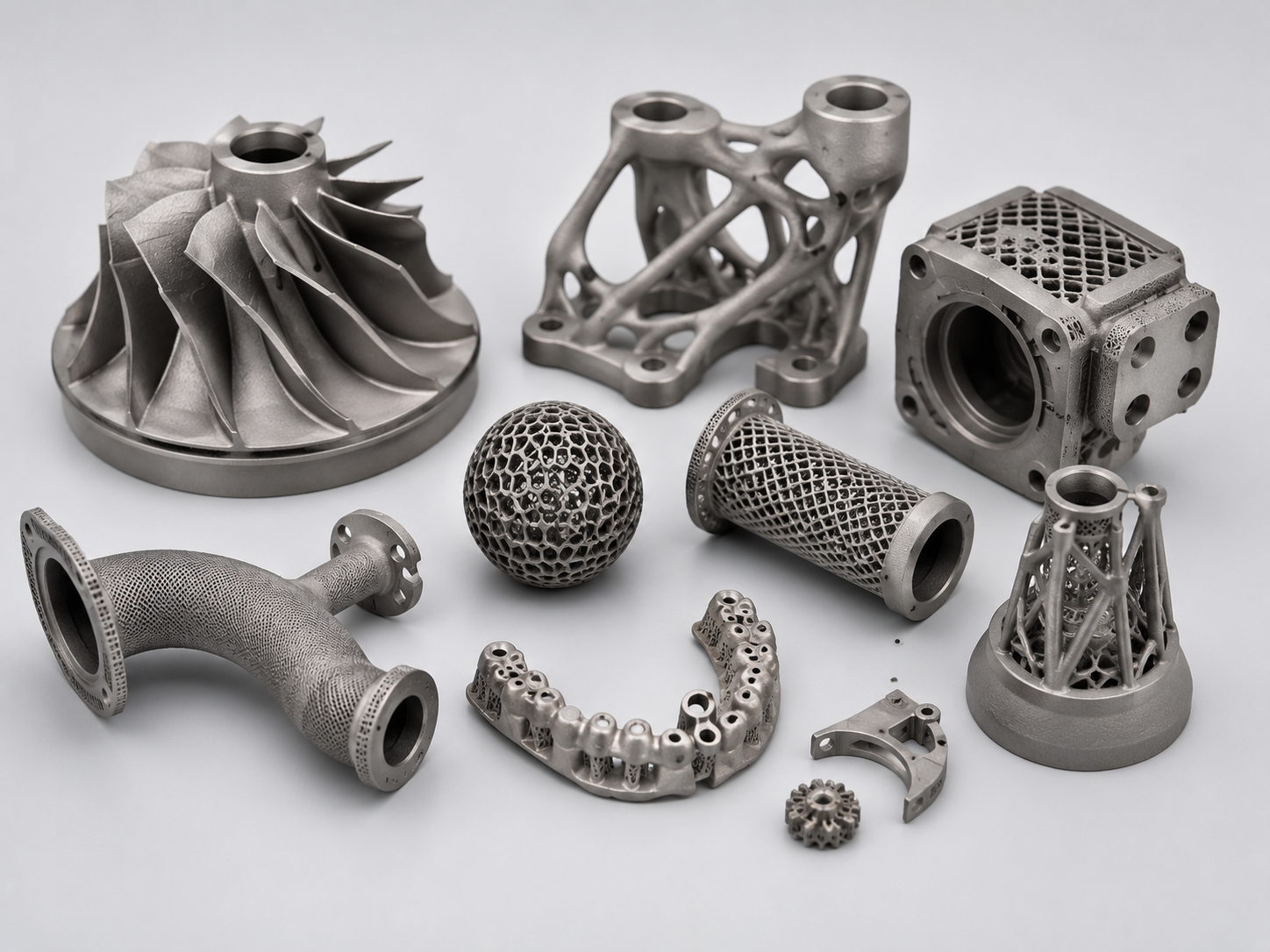
3D Printing Service for Custom Parts
On-demand 3D printing services for rapid prototyping and production, with lead times as fast as 1 day. Upload your 3D CAD file to receive an instant quote and automated Design for Additive Manufacturing (DfAM) analysis, helping you optimize part designs, reduce production costs, and accelerate time to market.
Certification
ISO 9001:2015
3D Printing Processes
Our online 3D printing service enables fast, on-demand production of custom parts for prototyping and end-use applications. Upload your 3D CAD file to receive an instant quote and manufacture high-quality plastic, metal, and elastomer components using a wide range of advanced additive manufacturing technologies.
To meet your exact performance and aesthetic requirements, we offer an extensive selection of engineering-grade materials along with value-added post-processing services, including polishing, dyeing, painting, machining, and surface finishing. From concept to production, we provide reliable manufacturing solutions with fast lead times and consistent quality.
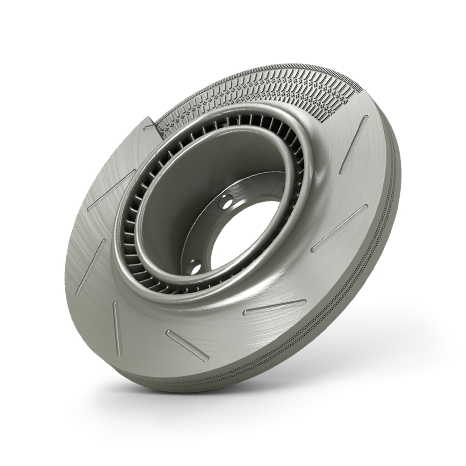
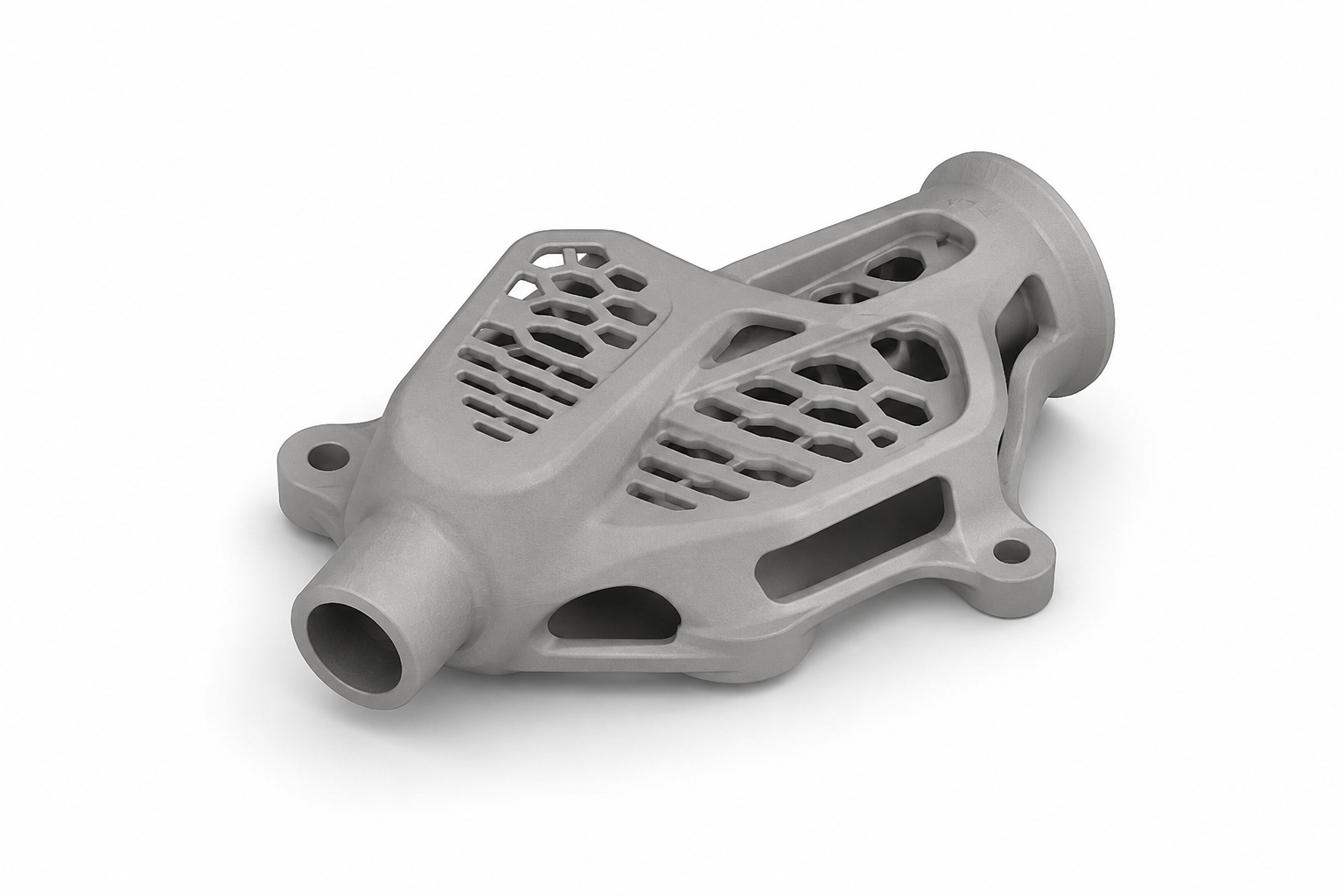
Metal 3D Printing
Compare 3D Printing Processes
New to our 3D printing service and not sure which additive technology is right for your 3D design? Compare the capabilities of each process below to see what fits your application's requirements.
| Materiales | Max Part Size | Min Feature Size | Tolerances | |
|---|---|---|---|---|
| Metal 3D Printing | Aluminum Stainless Steel (17-4, 316L) Titanium Inconel Cobalt Chrome |
9.6 in. x 9.6 in. x 13.0 in X Line: 31.5 in. x 15.7 in. x 19.7 in. |
0.006 in. | ±0.003 in |
| Stereolithography | ABS Polycarbonate Polypropylene Silicone |
29 in. x 25 in. x 21 in. | 0.0025 in. | ±0.002 in. |
| Selective Laser Sintering | Nylons Polypropylene TPU |
19 in. x 19 in. x 17 in. | 0.030 in. | ±0.010 in. |
| Multi Jet Fusion | Nylons | 11.1 in. x 14.9 in. x 14.9 in. | 0.020 in. | ±0.012 in. |
| PolyJet | Elastomer (30A to 95A) | 19.3 in. x 15.4 in. x 7.9 in. | 0.012 in. | ±0.005 in. |
| Advanced Photopolymer | Tough Black Ceramic-Filled Flame Retardant Black ESD Black Medical White |
9.8 in. x 5.5 in. x 19.4 in. | Tough Black = 0.100 in. Other materials = 0.020 in. |
Tough Black = ±0.010 in. Other materials = ±0.002 in. |
| Materiales | Max Part Size | Min Feature Size | Tolerances | |
|---|---|---|---|---|
| Metal 3D Printing | Aluminum Stainless Steel (17-4, 316L) Titanium Inconel Cobalt Chrome |
245mm x 245mm x 330mm X Line: 400mm x 800mm x 500mm |
0.1524mm | ±0.076mm |
| Stereolithography | ABS Polycarbonate Polypropylene Silicone |
736mm x 635mm x 533mm | 0.0634mm | ±0.0508mm |
| Selective Laser Sintering | Nylons Polypropylene TPU |
482mm x 482mm x 431mm | 0.762mm | ± 0.254mm |
| Multi Jet Fusion | Nylons |
281mm x 378mm x 378mm |
0.508mm | ±0.305mm |
| PolyJet | Elastomer (30A to 95A) | 490mm x 391mm x 200mm | 0.305mm | ±0.127mm |
| Advanced Photopolymers | Tough Black Ceramic-Filled Flame Retardant Black ESD Black Medical White |
249mm x 140mm x 499mm | Tough Black = 2.55mm Other Materiales = 0.5mm |
Tough Black = ±0.25mm Other Materiales = ±0.05mm |
3D Printing Materiales
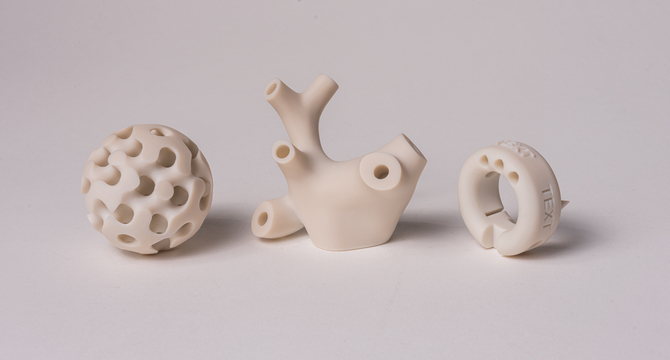
Plastic 3D Printing Materiales



Metal 3D Printing Materiales


Sample Quote
Explore our material feature that lets you compare the cost of 3DP processes, materials, and resolutions.
Surface Finish Options for 3D Prints
| Unfinished | Parts are delivered in their as-printed condition. Minor support marks, small contact points, or raised nibs may remain visible on surfaces where support structures were |
|---|---|
| Natural | Support contact areas are lightly sanded to remove support nibs and create a smoother, more uniform surface while preserving the material's natural appearance. |
| Standard | Support contact areas are sanded, and the entire part is fine bead blasted to create a clean, uniform matte appearance. Layer lines remain visible, but the overall surface finish is significantly improved. |
| Custom | A wide range of secondary finishing services is available, including soft-touch coating, clear part finishing, custom painting, masking, color matching, graphic decals, and textured surface finishes to enhance the appearance and functionality of your 3D printed parts. |
Custom Finishing
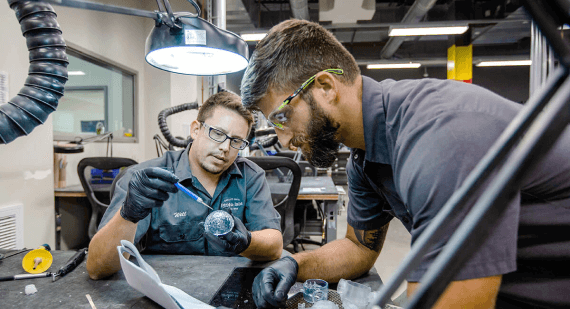
Enhance the strength, clarity, and appearance of your 3D printed parts with our comprehensive post-processing services. From specialized materials for microfluidic and high-resolution applications to metal plating, precision secondary machining, and custom surface finishes—including painting, clear coating, color matching, graphic decals, and textured finishes—we provide tailored solutions to meet your functional and aesthetic requirements.
| Clear Coat | Clear Cosmetic Finish enhances the optical appearance of transparent SLA parts by improving surface smoothness and clarity. This finishing option is available for ABS-Like Translucent/Clear (WaterShed® XC 11122) and PC-Like Translucent/Clear (Accura® 60) materials, making it ideal for prototypes and components requiring a clean, glass-like appearance. |
| Painting | After sanding and polishing, parts are professionally finished with automotive-grade paint to achieve a smooth, durable, and high-quality appearance. Custom color matching is available—simply provide your Pantone® color code when requesting a quote. We also offer soft-touch coatings for applications requiring a premium tactile finish. |
| Plating | Electroless nickel plating provides a durable, corrosion-resistant metallic finish that gives 3D printed or machined parts the appearance and feel of cast aluminum or magnesium. This finish enhances surface hardness, wear resistance, and dimensional stability while delivering a uniform, high-quality metallic appearance. |
| Dyeing | Dyeing is a fast and cost-effective method for adding color to 3D printed parts. Compared with painting, it offers shorter lead times and a more economical solution while providing consistent, durable color. Although the available color selection is more limited, dyeing is an excellent choice for functional prototypes and production parts. |
| Decaling | Add custom logos, graphics, and labels to improve the appearance, branding, and functionality of your 3D printed parts. |
| Polishing | Achieve a smooth, mirror-like surface finish with our professional polishing service. Please provide a drawing, reference image, or finish specification when requesting a quote to ensure your cosmetic requirements are met. |
| Heat Treatment | Improve the strength and performance of metal 3D printed parts with advanced heat treatment services, including NADCAP-certified heat treatment, HIP, solution annealing, and age hardening. |
| Machining | Precision CNC machining enhances metal 3D printed parts by improving surface finish, achieving tight dimensional tolerances, and creating critical features for production-ready applications. |
Why Choose Us for Custom 3D Printing?
Engineering Expertise
Our experienced engineering team provides Design for Additive Manufacturing (DfAM) support to optimize your designs for quality, performance, and manufacturability. We help identify the best printing technology, material, and build orientation to achieve superior results.
Broad Material & Technology Selection
We offer a wide range of industrial 3D printing technologies and engineering-grade materials for plastic, elastomer, and metal parts. Comprehensive post-processing services—including heat treatment, CNC machining, plating, polishing, painting, and dyeing—allow us to deliver production-ready components with outstanding performance and appearance.
Scalable Manufacturing
From one-off prototypes to full-scale production, our flexible manufacturing provides reliable capacity, fast lead times, and consistent quality to support every stage of your product lifecycle.
Transparent Pricing & No MOQ
Our on-demand manufacturing model gives you the flexibility to order exactly what you need, with no minimum order quantity. Reduce inventory costs, respond quickly to market demand, and scale production efficiently with competitive pricing and dependable delivery.
What is 3D Printing?
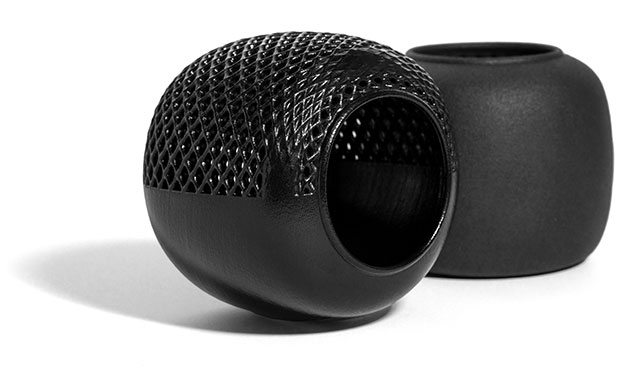
3D printing, also known as additive manufacturing, is an advanced manufacturing process that builds parts layer by layer directly from a digital 3D CAD model. By adding material only where needed, it enables the efficient production of complex geometries, lightweight structures, and highly customized components with minimal material waste.
Depending on the selected technology, 3D printing can produce plastic, elastomer, resin, and metal parts using processes such as material extrusion, powder bed fusion, and vat photopolymerization. Each process offers unique advantages in terms of material compatibility, dimensional accuracy, surface finish, mechanical performance, production speed, and cost, making 3D printing an ideal solution for rapid prototyping, bridge manufacturing, and end-use production.
Advantages of 3D Printing
3D printing, or additive manufacturing, unlocks design freedom and manufacturing flexibility that traditional processes such as injection molding, CNC machining, and casting cannot easily achieve. By building parts layer by layer, it enables faster product development, reduced production costs, and the creation of highly complex, lightweight components.
Key Benefits
-
Complex Geometries Without Added Cost
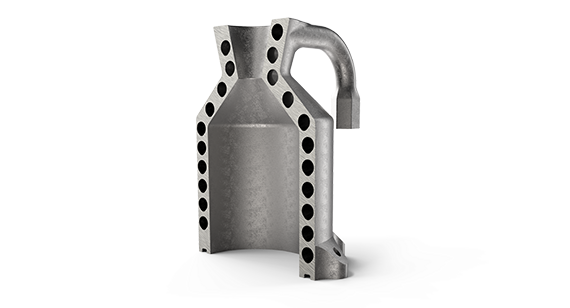
Manufacture intricate internal channels, lattice structures, undercuts, and organic shapes with minimal impact on part cost. -
Part Consolidation
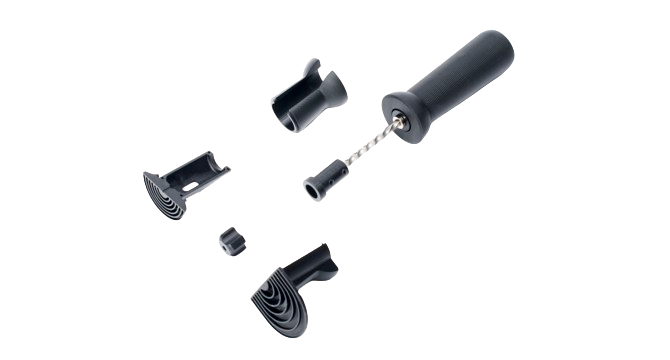
Combine multiple components into a single printed part, reducing assembly time, fasteners, and potential failure points. -
No Tooling Investment
Eliminate the need for molds, dies, or dedicated tooling, making 3D printing ideal for prototypes, custom parts, and low-volume production. -
Rapid Production
Produce high-quality parts in as fast as 24 hours, accelerating product development and reducing time to market. -
Optimized Internal Features
Create complex internal channels and conformal geometries for improved fluid flow, heat transfer, and lightweight performance.
Common 3D Printing Applications
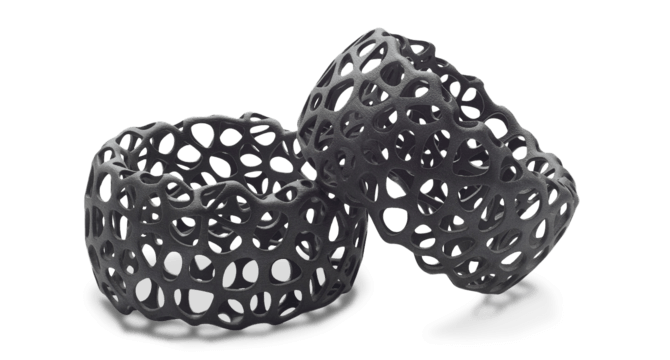
From concept validation to end-use production, additive manufacturing supports a wide range of industries by enabling rapid product development, lightweight designs, and highly customized components.
Typical applications include:
- Concept, Form & Fit Prototypes
- Functional Testing Parts
- Production Tooling
- Housings & Protective Enclosures
- Jigs, Fixtures & Assembly Aids
- Medical Devices & Surgical Instruments
- Heat Exchangers & Thermal Management Components
- Engine, Turbine & Powertrain Components
- Fuel System Components
- End-Use Production Parts
Get an Instant 3D Printing Quote
Upload a 3D CAD file to get an instant quote on your 3D printing design.
3D Printing FAQs
How do I choose a 3D printing technology?
expand_less expand_moreThe right 3D printing technology depends on your application's performance requirements. Consider factors such as strength, temperature resistance, water resistance, surface finish, aesthetics, and durability to determine whether plastic or metal 3D printing is the best choice.
What type of file format is needed for 3D printing?
expand_less expand_moreWe recommend uploading native CAD files such as STEP, SOLIDWORKS, or IGES for the most accurate quoting and manufacturing. Although all files are converted to STL format before printing, native CAD files preserve design integrity and improve manufacturability analysis.
How large of a part can you 3D print?
expand_less expand_moreMaximum part size depends on the selected 3D printing process and material. Our large-format additive manufacturing systems support metal parts up to 31.5 × 15.7 × 19.7 in. and plastic parts up to 29 × 25 × 21 in. Larger components may be produced using segmented manufacturing and precision assembly techniques.
What are the advantages of 3D printing?
expand_less expand_more3D printing, or additive manufacturing, unlocks design freedom and manufacturing flexibility that traditional processes such as injection molding, CNC machining, and casting cannot easily achieve. By building parts layer by layer, it enables faster product development, reduced production costs, and the creation of highly complex, lightweight components.
What is 3D printing used for?
expand_less expand_more3D printing has evolved far beyond rapid prototyping. Thanks to advancements in engineering-grade materials, printing technologies, and post-processing capabilities, additive manufacturing is now widely used for both functional prototypes and end-use production parts across a wide range of industries.